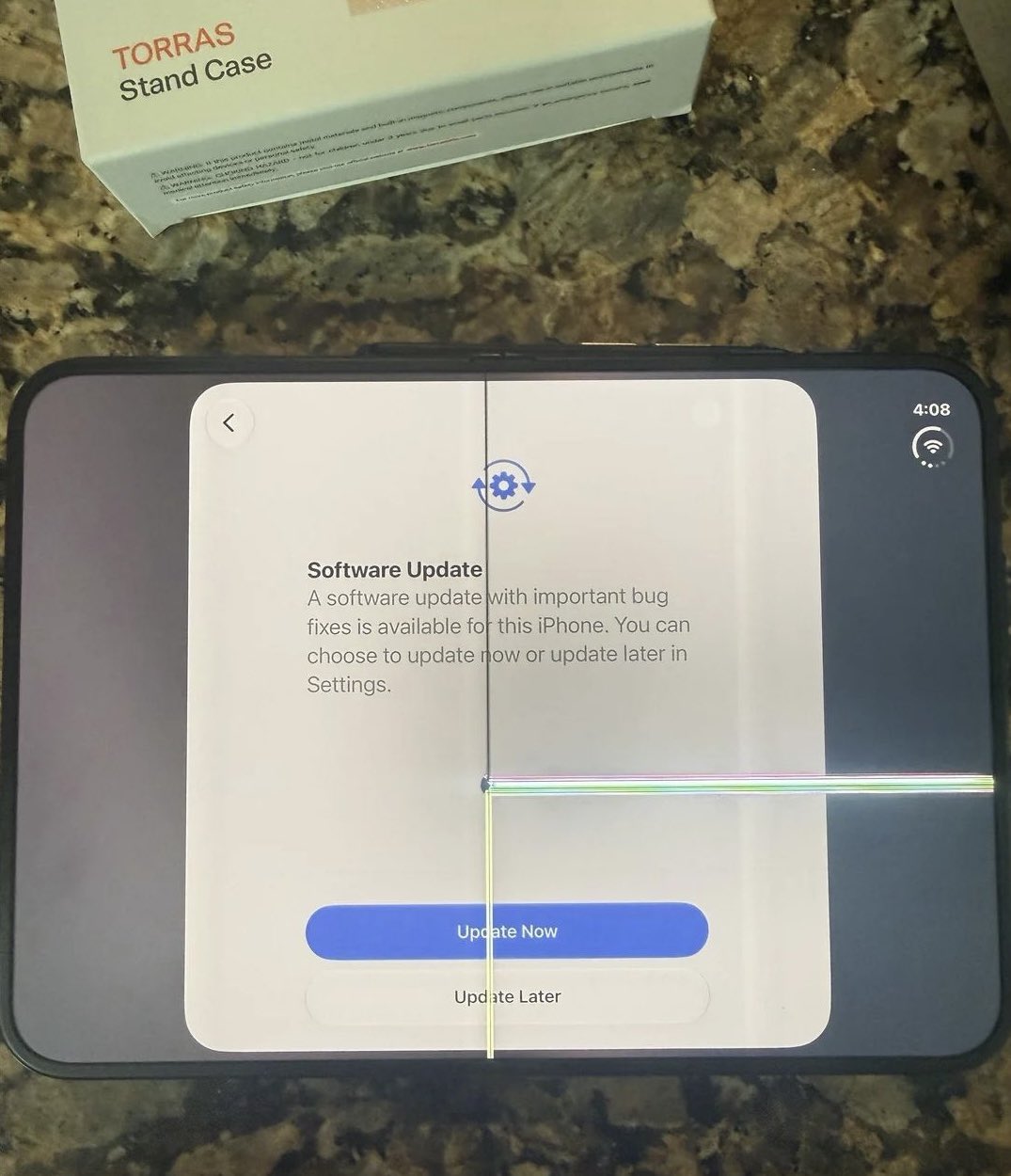
Apple’s first foldable iPhone reached customers on Friday, and launch weekend has already produced an unwelcome pattern: several owners say the iPhone Duo’s inner display cracked along the center hinge, sometimes within hours of unboxing it.
The photos and accounts are strikingly similar. The damage tends to follow the fold, with a bright horizontal band or block of dead pixels extending from the center. In at least a few cases, owners said the phone had not been dropped and showed no obvious exterior damage before the display failed.
That is enough to take seriously, but not enough to declare a full-blown “crackgate.” Here is what we know so far — and what remains speculation.
A small number of reports, one consistent failure pattern
9to5Mac counted about ten distinct cases by Sunday morning. Some owners reported that the problem appeared during initial setup, while others used their phones for several hours before hearing or feeling something near the hinge and seeing the inner screen fail.
MacRumors documented one Australian owner’s experience after fewer than 20 openings. The phone reportedly cracked along the hinge despite having no visible marks on the display or exterior hinge. Apple replaced that unit at an Apple Store.
Several affected customers have reportedly received direct replacements from Apple, although buyers who purchased through carriers may face stock shortages or a slower exchange process.
Why the center fold matters
The Duo’s 7.6-inch inner display is not ordinary cover glass. It has to bend thousands of times while its layers move across one another. Apple says the display uses high-strength glass, custom adhesives, a polymer cover layer, and a titanium support plate to manage that stress. The hinge contains more than 100 components and supports the center of the panel when the phone is open.
That engineering makes the repeated location of these failures noteworthy. One theory circulating online is that a misaligned hinge component may press upward into the flexible display. Another is that closing the phone by pushing directly on the center of the screen adds concentrated pressure. Neither explanation has been confirmed, and Apple has not issued special folding instructions or announced a defect.
Foldable screens are also inherently more delicate than the rigid glass displays most iPhone owners know. The inner surface can be damaged by pressure or debris that would not bother a conventional phone. The Duo’s outer display is protected by Ceramic Shield 2, but its folding inner panel relies on a softer layered construction.
Is this a widespread problem?
We do not know yet. The iPhone Duo has been in customers’ hands for only a few days, and online posts can make a small number of failures appear larger than they are. Apple has likely shipped hundreds of thousands of units, while the number of independently identifiable cracked-screen reports remains comparatively small.
There are also reasons not to panic. Reviewers performed extensive folding and durability tests before launch without reproducing the same failure. Apple Stores are not being described as overwhelmed with Duo repairs. A handful of defective units could point to an isolated manufacturing batch rather than a fundamental design flaw.
Still, the similar location and appearance of the damage deserve attention. If reports continue to grow over the next week, Apple may need to explain whether it has identified a component, manufacturing, or handling issue.
What iPhone Duo owners should do
- Do not remove the inner display’s cover layer. It is part of the screen assembly, even though Apple has described it as service-replaceable.
- Keep the fold clean. Check for grit or debris before closing the phone, and do not place objects between the two halves.
- Avoid pressing on the center crease. Until Apple offers definitive guidance, close the phone using its frame rather than pushing directly on the flexible display.
- Document any failure immediately. Take photos of the screen, hinge, and exterior before visiting Apple Support or the retailer.
- Use the return window. A new phone that cracks during normal use should be inspected promptly rather than repeatedly opened and closed.
The bottom line
The iPhone Duo is Apple’s most ambitious iPhone design in years, and it starts at $1,999. Buyers are justified in expecting the inner screen to survive normal opening and closing. The current evidence shows a real pattern among a limited number of early units, but it does not yet establish how common the problem is or what causes it.
For now, Duo owners should handle the inner display carefully, watch the center fold for unusual resistance or pixel artifacts, and contact Apple quickly if anything changes. We will update this story if Apple comments or the number of verified cases grows.
Leave a Reply